Mammal · Aquarium
Planet Zoo 2 West Indian Manatee: Habitat Size, Temperature & Needs
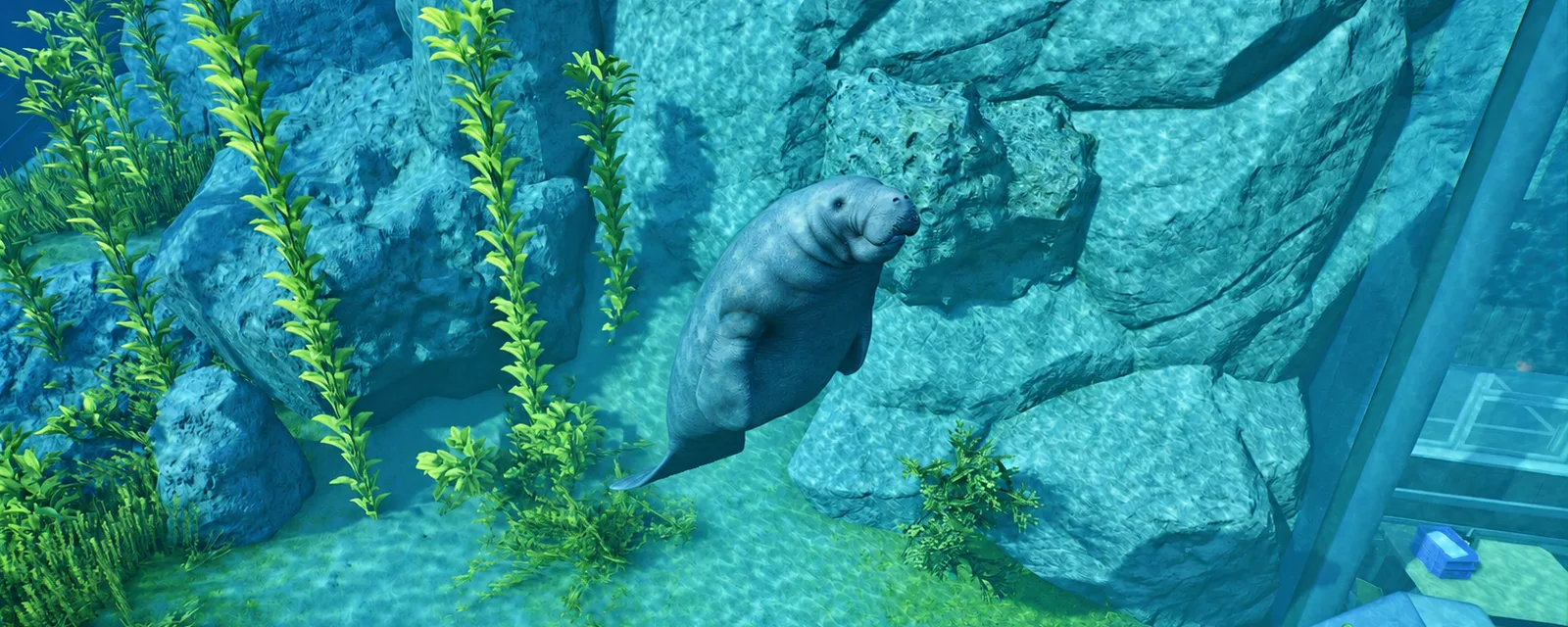
Plan a West Indian Manatee habitat by checking adult-count areas, temperature and barriers, then compare its biomes with other animals. The West Indian Manatee (Trichechus manatus) lives in an aquarium in Planet Zoo 2. The official Zoopedia lists its biome as Estuarine, Lakes and Rivers, Mangrove, Open Sea and Wetlands and its wild range as North America and South America; it is vulnerable in the wild. Each checked requirement below shows its evidence grade and source.
Last updated Game version: Launch edition (October 13, 2026); build number not confirmed
Plan for your West Indian Manatee
Set the adult count and add other species to compare shared biomes and checked requirements. For a fresh selection, use the Habitat Planner.
- West Indian Manatee
Shared biomes and regions
Biomes: Estuarine, Lakes and Rivers, Mangrove, Open Sea, Wetlands.
Regions: North America, South America.
A shared biome does not confirm that animals can live together.
Area for your adult counts
Exact outputs checked on the official Zoopedia. We do not multiply the one-adult value or extrapolate other counts. Area categories can overlap; do not add them together.
West Indian Manatee · 1 adult
Within the published mixed-group range (1–8). Sex ratios still need checking.
- Deep water area
- 20 m²
- Aquatic area
- 150 m²
Checked counts: 1, 2, 3, 4, 5, 6. Official Habitat panel · Grade A · 2026-10-13.
Temperature and barrier comparison
Shared temperature: 23°C to 30°C
Strongest barrier: Grade 2.
Tallest barrier: 1 m.
These compare the published numbers. Roofs, climb-proofing, water conditions and mixed-species safety need separate checks.
Plans stay in this browser. No account needed.
In-game needs
The area rows below show the official control set to 1 adult; this is a reference, not a recommended group. The published mixed-group range is 1 - 8. Use the tool above for checked group sizes. Missing fields mean Not confirmed yet, not zero.
| Need | In the game | Confirmed by |
|---|---|---|
| Temperature | 23°C to 30°C | Grade A · OfficialFrontier DevelopmentsChecked October 13, 2026 (Launch edition (October 13, 2026); build number not confirmed) |
| Deep water area | 20m²Official adult-count control set to 1. This is an area reference, not a recommended group size. | Grade A · OfficialFrontier DevelopmentsChecked October 13, 2026 (Launch edition (October 13, 2026); build number not confirmed) |
| Aquatic area | 150m²Official adult-count control set to 1. This is an area reference, not a recommended group size. | Grade A · OfficialFrontier DevelopmentsChecked October 13, 2026 (Launch edition (October 13, 2026); build number not confirmed) |
| Group size | 1 - 8 | Grade A · OfficialFrontier DevelopmentsChecked October 13, 2026 (Launch edition (October 13, 2026); build number not confirmed) |
| Male-only group | 1 - 8 | Grade A · OfficialFrontier DevelopmentsChecked October 13, 2026 (Launch edition (October 13, 2026); build number not confirmed) |
| Female-only group | 1 - 8 | Grade A · OfficialFrontier DevelopmentsChecked October 13, 2026 (Launch edition (October 13, 2026); build number not confirmed) |
| Maximum males | 7 | Grade A · OfficialFrontier DevelopmentsChecked October 13, 2026 (Launch edition (October 13, 2026); build number not confirmed) |
| Maximum females | 7 | Grade A · OfficialFrontier DevelopmentsChecked October 13, 2026 (Launch edition (October 13, 2026); build number not confirmed) |
| Sand | 30% to 100% | Grade A · OfficialFrontier DevelopmentsChecked October 13, 2026 (Launch edition (October 13, 2026); build number not confirmed) |
| Soil | 0% to 50% | Grade A · OfficialFrontier DevelopmentsChecked October 13, 2026 (Launch edition (October 13, 2026); build number not confirmed) |
| Rock | 0% to 30% | Grade A · OfficialFrontier DevelopmentsChecked October 13, 2026 (Launch edition (October 13, 2026); build number not confirmed) |
| Barrier strength | Grade 2 | Grade A · OfficialFrontier DevelopmentsChecked October 13, 2026 (Launch edition (October 13, 2026); build number not confirmed) |
| Barrier height | 1m | Grade A · OfficialFrontier DevelopmentsChecked October 13, 2026 (Launch edition (October 13, 2026); build number not confirmed) |
| Thriving relationships | No compatible species listedOnly explicit official relationships confirm a pairing. Absence from the list is not proof that a pair cannot live together. | Grade A · OfficialFrontier DevelopmentsChecked October 13, 2026 (Launch edition (October 13, 2026); build number not confirmed) |
| Neutral relationships | No compatible species listedOnly explicit official relationships confirm a pairing. Absence from the list is not proof that a pair cannot live together. | Grade A · OfficialFrontier DevelopmentsChecked October 13, 2026 (Launch edition (October 13, 2026); build number not confirmed) |
| Salinity | Any Salinity | Grade A · OfficialFrontier DevelopmentsChecked October 13, 2026 (Launch edition (October 13, 2026); build number not confirmed) |
| Land area | Not confirmed yet | No checked source |
| Climbing area | Not confirmed yet | No checked source |
| Wildlife Reserve | Not confirmed yet | No checked source |
Before you build
- Check group composition first: the mixed-group range is 1 - 8; the male-only, female-only and maximum-per-sex limits are listed separately above.
- Keep the habitat within the published 23°C to 30°C range. Compare every selected species before choosing a shared temperature.
- Compare these barrier requirements before building: Barrier strength Grade 2; Barrier height 1m.
- Use the area value for the checked adult count. Shelter, water, climbing and flight areas remain separate requirements, and mixed-species totals are not confirmed.
Animals that share its biome
Other aquarium animals the Zoopedia lists for at least one of the same biomes: Hawksbill Turtle, Indo-Pacific Leopard Shark, Blacktip Reef Shark, Giant Grouper, Javanese Cownose Ray, Ocellated Eagle Ray, African Tigerfish, Blunthead Cichlid, Boeseman's Rainbowfish, Brown Trout, Clown Loach and Common Rudd. Sharing a biome does not mean they can share a habitat; the game's own Zoopedia says which species can live together.
Compare more animals on the Planet Zoo 2 biomes page, or see all Planet Zoo 2 aquatic animals. The full Planet Zoo 2 animal list has every species.
West Indian Manatee questions
What biome does the West Indian Manatee need in Planet Zoo 2?
The official Zoopedia lists the West Indian Manatee for the Estuarine, Lakes and Rivers, Mangrove, Open Sea and Wetlands biomes. In the wild it lives in North America and South America.
How much habitat space does the West Indian Manatee need?
For 1 adult, the official Zoopedia shows Deep water area: 20 m²; Aquatic area: 150 m². These are separate area categories, not values to add together. Use the tool for other checked counts; unverified counts stay unknown.
What temperature does the West Indian Manatee need?
23°C to 30°C is the published habitat temperature range. This comes from the visible Habitat panel of Frontier's online Zoopedia, checked October 13, 2026.
What barrier does the West Indian Manatee need?
Barrier strength: Grade 2; Barrier height: 1m. These are the published requirements; additional construction details are not confirmed here.
Which animals can live with the West Indian Manatee?
Not confirmed yet. No companion species appear in our checked official relationship records for this animal; that is not proof that every pairing is impossible.
Sources
Checked against the official pages on October 13, 2026. Grade A: visible official Habitat panels. Grade B: two independent sources agree. Grade C: unverified player reports, excluded from tools. Adult-count area outputs were checked individually; no formula is inferred.
Continue reading
Next stepBuilding a tank? See every Planet Zoo 2 aquarium animal.Planet Zoo 2 Aquatic Animals and Sharks ListAll aquarium animals: fish, sharks, rays, the sea turtle and the manatee, by water biome, with the fish that also fit an exhibit.Go thereRelated pages
 BirdPlanet Zoo 2 African Penguin: Habitat & NeedsThe African Penguin's in-game needs checked in the released game, its terrestrial habitat and biome, and the animals that share its biome.
 MammalAsian Small-Clawed Otter in Planet Zoo 2The Asian Small-Clawed Otter's in-game needs checked in the released game, its terrestrial habitat and biome, and the animals that share its biome.
 ReptilePlanet Zoo 2 Hawksbill Turtle: Habitat & NeedsThe Hawksbill Turtle's in-game needs checked in the released game, its aquarium habitat and biome, and the animals that share its biome.
Card pictures: Processed screenshot: Planet Zoo 2 © Frontier Developments