Mammal · Terrestrial
Planet Zoo 2 Giant Panda: Habitat Size, Temperature & Needs
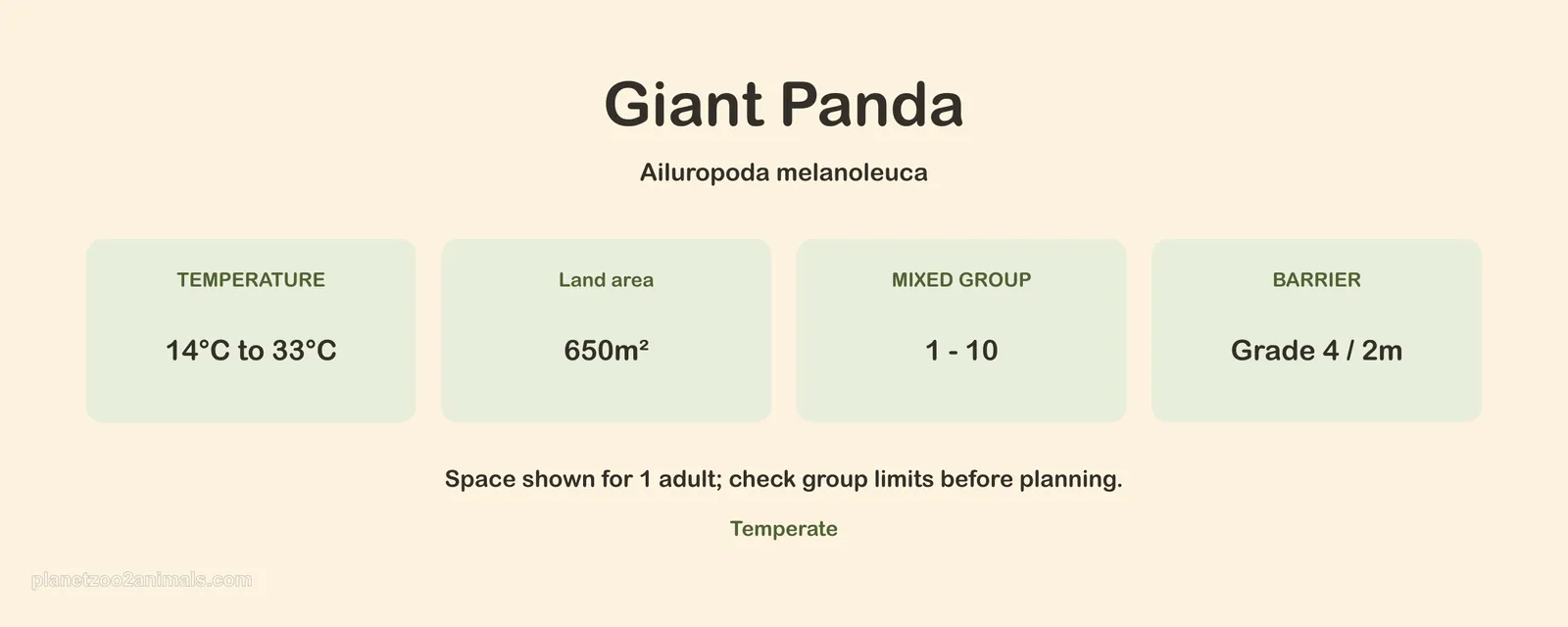
Giant pandas in Planet Zoo 2 need 650 m² of land and 15 m² of shelter for one panda, a climb-proof Grade 4 barrier 2 m high and a temperature of 14°C to 33°C. They are rated very difficult to breed, and the red panda is the only species on their official companion list.
Last updated Game version: Launch version (October 13, 2026)
Quick answer: 1 adult, the smallest group
- Land area
- 650 m²
- Shelter area
- 15 m²
- Temperature
- 14°C to 33°C
- Barrier
- Grade 4, 2m, climb-proof
- Group size
- 1 - 10, up to 9 males
- Each extra adult
- +150 m² land, +15 m² shelter
- Lives with
- Neutral: Red Panda
- Breeding: very difficult: spring only, one cub at a time, at best one every two years. How to get a cub
- Unhappy panda: its Info Panel shows which part of welfare is low; then check food, water, space, ground, temperature, shelter and toys. What to fix
- A pair: 800 m² of land and 30 m² of shelter, a climb-proof Grade 4 barrier and 14°C to 33°C. Build it step by step
Plan for your Giant Panda
Adults of each animal:
- Giant Panda
Shared biomes and regions
Biomes: Temperate.
Regions: Asia.
Area for your adult counts
Giant Panda · 1 adult
Within the published mixed-group range (1–10).
Sex limits: Male-only group 1 - 10 · Female-only group 1 - 10 · Maximum males 9 · Maximum females 9.
- Land area
- 650 m²
- Shelter area
- 15 m²
Each extra adult adds: Land area 150 m², Shelter area 15 m².
Temperature, terrain and barrier
Shared temperature: 14°C to 33°C
Terrain every selected animal accepts: Grass 10% to 50%, Sand 0% to 40%, Soil 20% to 60%, Rock 10% to 50%, Snow 0% to 100%. One mix that adds up to 100% and fits every selected animal: Snow 60%, Soil 20%, Grass 10%, Rock 10%.
Strongest barrier: Grade 4.
Tallest barrier: 2 m.
Climb-proof barrier: Needed. Giant Panda needs one.
Water as the barrier: Not allowed. Giant Panda does not accept a water barrier.
In-game needs
| Need | In the game |
|---|---|
| Temperature | 14°C to 33°C |
| Land area (1 adult) | 650m² |
| Group size | 1 - 10 |
| Male-only group | 1 - 10 |
| Female-only group | 1 - 10 |
| Maximum males | 9 |
| Maximum females | 9 |
| Grass | 10% to 50% |
| Sand | 0% to 40% |
| Soil | 20% to 60% |
| Rock | 10% to 50% |
| Snow | 0% to 100% |
| Barrier strength | Grade 4 |
| Barrier height | 2m |
| Thriving relationships | No compatible species listed |
| Neutral relationships | Red Panda |
| Shelter area (1 adult) | 15m² |
| Climb-proof barrier | Required |
| Water as the barrier | Not allowed |
Building the Giant Panda habitat
| Barrier types strong enough (Grade 4 or higher) | Acrylic, Steel Mesh, Thick Glass, Brick, Concrete, Gabion, Electric |
Giant Panda habitat size by number of adults
| Adults | Land area | Shelter area |
|---|---|---|
| 1 | 650 m² | 15 m² |
| 2 | 800 m² | 30 m² |
| 3 | 950 m² | 45 m² |
| 4 | 1,100 m² | 60 m² |
| 5 | 1,250 m² | 75 m² |
| 6 | 1,400 m² | 90 m² |
| 7 | 1,550 m² | 105 m² |
| 8 | 1,700 m² | 120 m² |
| 10 | 2,000 m² | 150 m² |
Room to be alone
A group can hold 1 to 10 pandas in any mix, up to 9 of either sex, but each extra panda adds 150 m² of land and 15 m² of shelter: two need 800 m² and 30 m², four need 1,100 m² and 60 m².
The Zoopedia's description stresses that pandas are solitary, that females defend their territory against rivals, and that they need enough space to keep to themselves.
Temperate ground, snow allowed
The panda is listed only for the Temperate biome. Soil should cover 20% to 60% of the ground, grass and rock 10% to 50% each, and sand up to 40%; snow is fine on any share of it, from none to all. The barrier must be climb-proof as well as Grade 4 and 2 m high, and water does not count as one.
Its food enrichment is the Foraging Wall, Melon Feeder, Fixed Roller Feeder - Small and Tree Scatter Feeder; Wind Chimes, a Bobbin Drum and a Herb Scent Marker are on its habitat list. Feeding a panda costs $1,089 per period. The red panda is listed as a neutral companion.
Panda unhappy? What to check
Welfare has four parts: Animal Status (how hungry, thirsty, comfortable, relaxed, clean and safe it is), Social (group size and space), Environment (terrain, plants and drinking water) and Enrichment (toys and feeders, more for a bigger group). The panda's Info Panel shows which part is low. Work down this list:
- Hungry: Keepers can prepare food only in a Keeper Hut, and it has to be within range of the habitat. If food is not arriving, the keepers not feeding checklist goes through the hut, tasks and Work Zones. Its feeders are the Foraging Wall, Melon Feeder, Fixed Roller Feeder - Small and Tree Scatter Feeder.
- Thirsty: clean drinking water it can reach. Animals need to drink at least once a season.
- Too crowded: 650 m² of land and 15 m² of shelter for the first panda, then 150 m² and 15 m² more for each one after it.
- Ground wrong: soil 20% to 60%, grass and rock 10% to 50% each and sand at most 40%; snow can cover anything from none of it to all of it.
- Too hot or too cold: keep it within 14°C to 33°C. Shelter is cooler in hot weather and warmer in cold, so a panda under cover copes better.
- Stressed: the more guests watch a panda, the more stressed it gets. Shelter lets it hide, but only if it can get right underneath and the shelter is big enough.
- Bored: add toys from its list, the Rubbing Pillar, Bobbin Drum, Bobbin, Wind Chimes, Small Ball, Small Ice Ball and Herb Scent Marker. More pandas need more enrichment.
- Fighting: too many pandas or too many of one sex. A group takes 1 to 10, at most 9 of either sex. A panda the group rejects only fights the others, so move it out, and have a place ready before a cub grows up.
A habitat for a pair, ready to build
Wild pandas live alone, but in the game a male and a female can share one habitat as long as each has its space. Everything the pair needs:
- Land 800 m² and shelter 30 m².
- A Grade 4 barrier 2 m high that is climb-proof; water does not count as a barrier.
- A temperature of 14°C to 33°C, in the Temperate biome.
- Ground of soil 20% to 60%, grass 10% to 50%, rock 10% to 50% and up to 40% sand; snow is optional.
- Drinking water inside the habitat, and plants from its native Temperate environment.
- Feeders from its food list and a few toys from its habitat list.
- A Keeper Hut within range of the habitat.
- Open this pair in the habitat planner to change the count or check a red panda alongside them.
One cub every two years at best
The Zoopedia rates the giant panda very difficult to breed. Pandas mate only in spring; a female has a single cub after 4.2 months and can conceive again 20 months after the birth. Cubs are adults at 6, every one of them leaves once grown, and pandas live up to 30. The breeding guide lists what stops a pair from mating, and the genetics guide helps you pick an unrelated partner.
With an estimated 500 to 1,000 left in the wild, giant pandas are Vulnerable, yet the Zoopedia names no Wildlife Reserve for them. Pandas can be bought from accreditation tier 3 in Career; in Franchise they wait until tier 5.
- Put a healthy adult male and female in the same habitat. Pandas count as adults from 6.
- Wait for spring: pandas mate in no other season, and a mother cannot conceive again until 20 months after a birth.
- Keep welfare high. Low welfare and illness stop conception, and the Compare Mates panel, in the Genetics tab of the panda's Info Panel, names anything in the way.
- Keep rival mates out of the habitat: fewer of them means fewer distractions. Pick an unrelated partner with good genes; the genetics guide explains the letters.
- Research the giant panda: species Research unlocks fertility boosts on top of good welfare and genes.
- Plan where the cub goes. Every panda leaves its parents once grown, and no Wildlife Reserve takes pandas, so it needs a habitat of its own or a buyer.
Animals from the same biome as the Giant Panda
Other terrestrial animals the Zoopedia lists for at least one of the same biomes: Bactrian Camel, Eurasian Beaver, Eurasian Brown Bear, Eurasian Lynx, European Bison, Grey Wolf, Grizzly Bear, Mountain Hare, Red Deer, Red Panda and Wild Boar.
Giant Panda questions
How big is a giant panda habitat in Planet Zoo 2?
650 m² of land and 15 m² of shelter for one panda, plus 150 m² of land and 15 m² of shelter for each extra panda. Two pandas need 800 m² and 30 m².
Why won't my giant pandas breed in Planet Zoo 2?
Pandas are rated very difficult to breed and mate only in spring. Check that the pair are healthy adults, 6 or older, that their welfare is high and that the female is not still raising a cub: she cannot conceive again until 20 months after a birth. The Compare Mates panel in the Genetics tab names anything else in the way, and species Research unlocks fertility boosts.
What animals can live with giant pandas in Planet Zoo 2?
Only the red panda, which is on the giant panda's official list as a neutral companion.
What barrier do giant pandas need?
A climb-proof Grade 4 barrier at least 2 m high. Water cannot be used as the barrier.
Can giant pandas live together in Planet Zoo 2?
Yes. One habitat can hold 1 to 10 pandas in any mix, up to 9 of either sex, as long as each one after the first adds 150 m² of land and 15 m² of shelter. Move out any panda the group rejects.
How do you make giant pandas happy in Planet Zoo 2?
Keep them fed and watered, give each one its space and shelter, use soil, grass and rock in the right mix, hold the temperature between 14°C and 33°C and add feeders and toys from their lists. Their Info Panel shows which part of welfare is low.
What do giant pandas eat in Planet Zoo 2?
Bamboo and Nutritionally Complete Biscuits. For food enrichment use the Foraging Wall, Melon Feeder, Fixed Roller Feeder - Small or Tree Scatter Feeder. Pandas cost $1,089 per period to feed.
How do you get giant pandas to Thriving in Planet Zoo 2?
Research them over five levels: 6 objects or plants tagged Trees, then 2 Rubbing Pillars, grade 2 food at level 3, 50% native plants at level 4 and Water Surface Area at level 5. Panda research has no reserve gate, and fertility rises by 15% at level 2 and by 30% at level 5.
Sources
Checked against the official pages on November 22, 2026.
Continue reading

Related pages
 MammalPlanet Zoo 2 Eurasian Lynx: Habitat & NeedsThe Eurasian Lynx's in-game needs checked in the released game, its terrestrial habitat and biome, and the animals that share its biome.
 MammalPlanet Zoo 2 Grey Wolf: Habitat Size & NeedsThe Grey Wolf's in-game needs checked in the released game, its terrestrial habitat and biome, and the animals that share its biome.