Habitats
Planet Zoo 2 Shelter Area for Every Animal
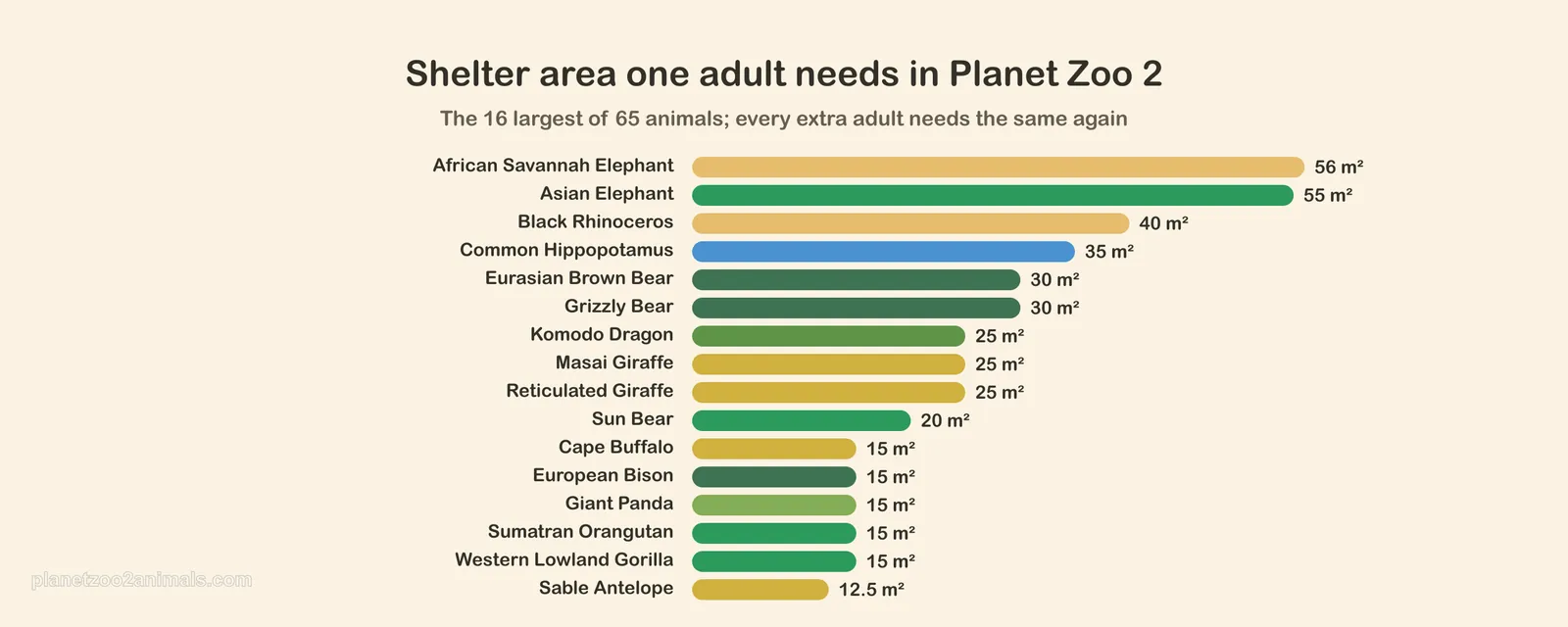
How much shelter each animal needs. 65 habitat and aviary animals list a shelter area in the official Zoopedia, from 1 m² to 56 m² per adult, and every extra adult needs the same again. Pick an animal and a number of adults to get the total.
Last updated Game version: Launch edition (October 13, 2026); build number not confirmed
Shelter area calculator
Shelter area for every animal
Largest need first. The Zoopedia's adult-count control was read at every count it allows for each animal, and for every one of them each adult adds exactly the same shelter as the first: one African Savannah Elephant needs 56 m², two need 112 m². The last column is the total for the smallest group the species accepts.
| Animal | Habitat | Shelter per adult | Group size | Smallest group needs |
|---|---|---|---|---|
| African Savannah Elephant | Terrestrial | 56 m² | 2–16 | 112 m² |
| Asian Elephant | Terrestrial | 55 m² | 3–30 | 165 m² |
| Black Rhinoceros | Terrestrial | 40 m² | 1–3 | 40 m² |
| Common Hippopotamus | Terrestrial | 35 m² | 3–30 | 105 m² |
| Eurasian Brown Bear | Terrestrial | 30 m² | 1–2 | 30 m² |
| Grizzly Bear | Terrestrial | 30 m² | 1–2 | 30 m² |
| Komodo Dragon | Terrestrial | 25 m² | 1–2 | 25 m² |
| Masai Giraffe | Terrestrial | 25 m² | 3–12 | 75 m² |
| Reticulated Giraffe | Terrestrial | 25 m² | 3–12 | 75 m² |
| Sun Bear | Terrestrial | 20 m² | 1–2 | 20 m² |
| Cape Buffalo | Terrestrial | 15 m² | 3–15 | 45 m² |
| European Bison | Terrestrial | 15 m² | 2–13 | 30 m² |
| Giant Panda | Terrestrial | 15 m² | 1–10 | 15 m² |
| Sumatran Orangutan | Terrestrial | 15 m² | 1–6 | 15 m² |
| Western Lowland Gorilla | Terrestrial | 15 m² | 3–6 | 45 m² |
| Sable Antelope | Terrestrial | 12.5 m² | 3–11 | 37.5 m² |
| Malayan Tapir | Terrestrial | 12 m² | 1–2 | 12 m² |
| Springbok | Terrestrial | 11 m² | 3–36 | 33 m² |
| Thomson's Gazelle | Terrestrial | 11 m² | 3–36 | 33 m² |
| Aardvark | Terrestrial | 10 m² | 1–2 | 10 m² |
| African Leopard | Terrestrial | 10 m² | 1–2 | 10 m² |
| African Wild Dog | Terrestrial | 10 m² | 2–27 | 20 m² |
| Black Wildebeest | Terrestrial | 10 m² | 4–20 | 40 m² |
| Blue Wildebeest | Terrestrial | 10 m² | 4–20 | 40 m² |
| Common Ostrich | Terrestrial | 10 m² | 1–8 | 10 m² |
| Common Warthog | Terrestrial | 10 m² | 1–7 | 10 m² |
| Eurasian Bittern | Flying | 10 m² | 1–2 | 10 m² |
| Eurasian Lynx | Terrestrial | 10 m² | 1–3 | 10 m² |
| Galápagos Giant Tortoise | Terrestrial | 10 m² | 1–4 | 10 m² |
| Gemsbok | Terrestrial | 10 m² | 5–10 | 50 m² |
| Golden Eagle | Flying | 10 m² | 1–2 | 10 m² |
| Grey Wolf | Terrestrial | 10 m² | 2–12 | 20 m² |
| Lion | Terrestrial | 10 m² | 2–30 | 20 m² |
| North Sulawesi Babirusa | Terrestrial | 10 m² | 1–5 | 10 m² |
| Nyala | Terrestrial | 10 m² | 1–5 | 10 m² |
| Plains Zebra | Terrestrial | 10 m² | 3–6 | 30 m² |
| Przewalski's Horse | Terrestrial | 10 m² | 3–8 | 30 m² |
| Red Deer | Terrestrial | 10 m² | 3–9 | 30 m² |
| Secretarybird | Flying | 10 m² | 1–2 | 10 m² |
| Siamang | Terrestrial | 10 m² | 2–6 | 20 m² |
| Snow Leopard | Terrestrial | 10 m² | 1–2 | 10 m² |
| Spotted Hyena | Terrestrial | 10 m² | 2–3 | 20 m² |
| Sumatran Tiger | Terrestrial | 10 m² | 1–2 | 10 m² |
| Toco Toucan | Flying | 10 m² | 1–2 | 10 m² |
| Western Chimpanzee | Terrestrial | 10 m² | 5–15 | 50 m² |
| White-Backed Vulture | Flying | 10 m² | 6–80 | 60 m² |
| White-Tailed Sea-Eagle | Flying | 10 m² | 1–2 | 10 m² |
| Wild Boar | Terrestrial | 10 m² | 3–30 | 30 m² |
| Goodfellow's Tree-Kangaroo | Terrestrial | 7.5 m² | 1–2 | 7.5 m² |
| Asian Small-Clawed Otter | Terrestrial | 5 m² | 2–15 | 10 m² |
| Eurasian Beaver | Terrestrial | 5 m² | 2–8 | 10 m² |
| Great Hornbill | Flying | 5 m² | 2–10 | 10 m² |
| Long-Eared Owl | Flying | 5 m² | 1–2 | 5 m² |
| Mountain Hare | Terrestrial | 5 m² | 1–5 | 5 m² |
| Red Panda | Terrestrial | 5 m² | 1–2 | 5 m² |
| Shoebill | Flying | 5 m² | 1–2 | 5 m² |
| Sunda Pangolin | Terrestrial | 5 m² | 1–2 | 5 m² |
| Binturong | Terrestrial | 4 m² | 1–5 | 4 m² |
| African Penguin | Terrestrial | 2 m² | 6–500 | 12 m² |
| Golden Lion Tamarin | Terrestrial | 2 m² | 2–8 | 4 m² |
| Greater Flamingo | Flying | 2 m² | 20–500 | 40 m² |
| Javan Green Magpie | Flying | 2 m² | 1–2 | 2 m² |
| Meerkat | Terrestrial | 2 m² | 2–30 | 4 m² |
| Ring-Tailed Lemur | Terrestrial | 2 m² | 3–30 | 6 m² |
| Long-Tailed Parakeet | Flying | 1 m² | 2–12 | 2 m² |
The Bactrian Camel, Gharial, Nile Monitor and Saltwater Crocodile list no shelter area at all. The other 67 animals live in aquariums or exhibits, whose panels have no shelter requirement.
How to build shelter that counts
Frontier's animal guide describes shelter as caves, overhangs and other solid structures where animals can rest and hide from guests and the weather. There are two ways to provide it:
- Ready-made shelters: open the Habitats tab of the browser, go to Bedding, Shelters and Nests, then Shelter, and filter by species to see the ones that suit your animal.
- Your own shelter: build caves and burrows from rocks, or use walls and roofs from Scenery for a man-made look. Anything that blocks sun or rain from the animal can work.
- Burrows: some species can also use Burrow objects with underground chambers to sleep or raise young. They are optional for welfare but count as shelter for animals that use them.
A shelter does not help if the animal cannot get underneath it or if it is too small for the animal, so check every new shelter with the Shelter Heatmap. Sheltered spots are cooler in hot weather and warmer in cold weather, and hiding places away from guests also cut stress for shy animals.
Biggest and smallest shelter needs
The African Savannah Elephant, Asian Elephant, Black Rhinoceros and Common Hippopotamus need the most shelter per adult, 35 m² or more. The Long-Tailed Parakeet need 1 m² each. Big herds add up fast: shelter scales with every adult, so plan it for the group you expect, not the animals you start with.
Shelter for aviary birds
12 aviary birds list a shelter area too, including the Long-Eared Owl (5 m² per adult) and the Toco Toucan (10 m² per adult). Their flight space is a separate requirement; the Planet Zoo 2 flyable area page lists it for every bird.
The Planet Zoo 2 habitat planner shows shelter alongside land, water, climbing and flight area for up to six species at a time, with the shared temperature and barrier.
Planet Zoo 2 shelter questions
What is shelter area in Planet Zoo 2?
The covered space a habitat gives its animals: caves, overhangs, roofs and other solid structures they can rest under, out of the weather and away from guests. Each animal’s Zoopedia entry lists how much it needs.
How much shelter does an animal need in Planet Zoo 2?
From 1 m² per adult for the Long-Tailed Parakeet to 56 m² per adult for the African Savannah Elephant. Every adult adds the same amount again, so 2 lions need 20 m².
How do you add shelter in Planet Zoo 2?
Place a ready-made shelter from the Habitats browser under Bedding, Shelters and Nests, filtered by species, or build your own from rocks, walls and roofs: anything that keeps sun or rain off the animal. Then check it with the Shelter Heatmap.
Why does my animal not count its shelter?
Frontier says a shelter does not work if the animal cannot get underneath it or if it is too small for the animal. Check it with the Shelter Heatmap and compare the habitat’s shelter with the amount the Zoopedia lists for your number of adults.
Do birds need shelter in Planet Zoo 2?
Yes. 12 aviary birds list a shelter area, from 1 m² to 10 m² per adult. A Long-Eared Owl needs 5 m² and a Toco Toucan 10 m² per adult.
Sources
- Planet Zoo 2 Zoopedia: the Habitat panel of each of the 69 habitat and aviary animals (official)
- Planet Zoo 2 player guide: Animals, on shelter and how to build it (official)
Checked against the official pages on October 19, 2026. Shelter areas were read from the official adult-count control at every count it allows, on October 19, 2026. Official information can change.
Continue reading
 Next stepShelter sorted? Check land, water and climbing space in the planner.Planet Zoo 2 Habitat Planner & CompatibilityCompare animal counts, checked space, shared temperature and barriers; see official relationship records and save your plan.Go there
Related pages
 AviariesPlanet Zoo 2 Flyable Area for Every BirdThe flight area every aviary bird needs, for one adult, its smallest group and each group size, and the two ways Frontier gives to add more.
 TerrainPlanet Zoo 2 Terrain Requirements by AnimalHow much grass, sand, soil, rock, waterlogged ground and snow each animal accepts or needs, with a finder by terrain type and a full table.

Card pictures: AI-edited game image: Planet Zoo 2 © Frontier Developments · Illustration: AI-generated artwork, not a game screenshot