Wildlife Reserves
Planet Zoo 2 Tanzania Reserve Animals and What Each Release Needs
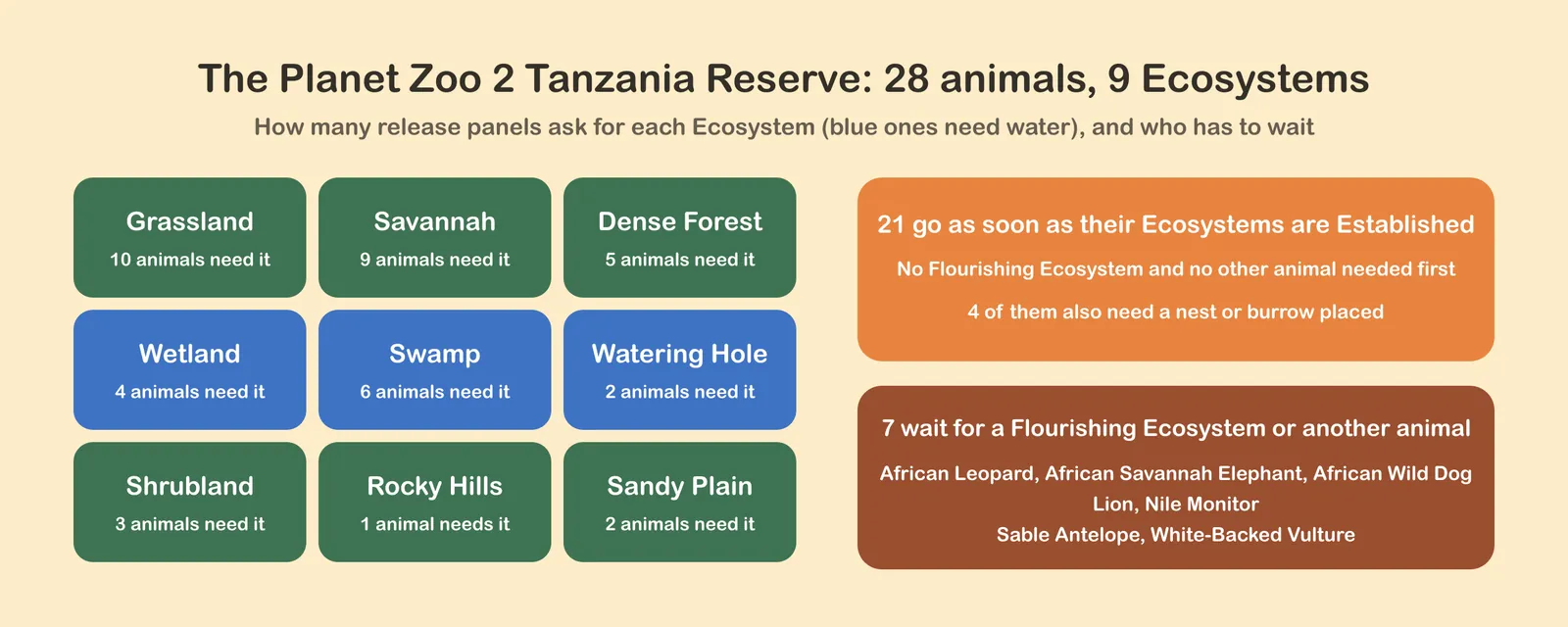
Tanzania shares the Grassland biome with the Great Rift Valley, and 26 of its 28 animals can go to either. Only the Common Ostrich and Thomson's Gazelle are Tanzania's alone. Below are a release checker, every release panel, the nine Ecosystems and the Career medals.
Last updated Game version: Update 1.0.11 (November 12, 2026)
Quick answer: 28 animals, nine Ecosystems, no Riverine
The Tanzania Reserve takes 28 species and has nine Ecosystems: Grassland, Savannah, Dense Forest, Wetland, Swamp, Watering Hole, Shrubland, Rocky Hills and Sandy Plain. Riverine is not one of them, so wherever a release panel says "or Riverine", build the other Ecosystem:
- African Leopard: Wetland
- African Savannah Elephant: Wetland
- African Wild Dog: Sandy Plain
- Greater Flamingo: Wetland
- Lion: Rocky Hills
- Nile Monitor: Wetland
21 animals can go as soon as their Ecosystems are Established. The other seven wait for a Flourishing Ecosystem or another animal.
The release checker covers all 28 animals and nine Ecosystems: tick what you have built and released, and it shows who can go now, what the rest still need and which Ecosystems are Flourishing. Your ticks are saved in this browser. Open the checker · Every release panel · Bronze to Gold
Which Tanzania animals can you release now?
Tick the Ecosystems your reserve has Established, then the animals already out. An Ecosystem turns Flourishing in the checker once the released animals cover all its roles, and each animal shows the panel lines it still waits for.
2. Tick the animals you have released
0 of 28 can go to Tanzania now · 0 released · 0 Ecosystems Flourishing. Your ticks stay in this browser.
What every Tanzania animal needs before release
These are the Species Release Requirements on each release group's panel, worded as the game words them. A plain name means the Ecosystem only has to be Established; "Flourishing" means its roles must be filled too.
| Animal | Ecosystems Required | Also needs | Roles it fills |
|---|---|---|---|
| Aardvark | Either Savannah or Shrubland | place a Burrows | Small Prey, Soil Rooters and Terrestrial Foragers |
| African Leopard | Either Wetland or Riverine; Flourishing Dense Forest | Medium Prey in the reserve | Predators |
| African Savannah Elephant | Flourishing Savannah; Either Flourishing Wetland or Flourishing Riverine | Nothing else | High Browsers, Terrestrial Foragers and Terrestrial Seed Dispersers |
| African Tigerfish | Swamp | Nothing else | Freshwater Fish and Underwater Predators |
| African Wild Dog | Savannah; Either Sandy Plain or Riverine | Medium Prey in the reserve | Predators |
| Black Rhinoceros | Grassland | Nothing else | Low Browsers and Terrestrial Seed Dispersers |
| Black Wildebeest | Grassland | Nothing else | Grazers, Medium Prey and Terrestrial Seed Dispersers |
| Blue Wildebeest | Grassland | Nothing else | Grazers, Medium Prey and Terrestrial Seed Dispersers |
| Blunthead Cichlid | Swamp | Nothing else | Freshwater Fish, Underwater Grazers and Small Underwater Prey |
| Cape Buffalo | Dense Forest | Nothing else | Low Browsers, Large Prey and Terrestrial Seed Dispersers |
| Common Hippopotamus | Swamp | Nothing else | Grazers and Wetland Engineers |
| Common Ostrich | Either Savannah or Grassland; Shrubland | Nothing else | Grazers, Medium Prey and Terrestrial Seed Dispersers |
| Common Warthog | Either Grassland or Shrubland | Nothing else | Medium Prey, Soil Rooters and Terrestrial Spore Dispersers |
| Gemsbok | Savannah | Nothing else | Medium Prey and Terrestrial Seed Dispersers |
| Greater Flamingo | Either Riverine or Wetland; Either Swamp or Watering Hole | place a Mud Mound Nest | Aerial Seed Dispersers and Small Prey |
| Lion | Either Rocky Hills or Riverine; Flourishing Savannah | Medium Prey in the reserve | Predators |
| Masai Giraffe | Dense Forest | Nothing else | High Browsers and Terrestrial Seed Dispersers |
| Nile Monitor | Either Wetland or Riverine; Swamp | Predators in the reserve | Predators and Scavengers |
| Nyala | Dense Forest | Nothing else | Grazers, Medium Prey and Terrestrial Seed Dispersers |
| Plains Zebra | Grassland; Watering Hole | Nothing else | Grazers, Medium Prey and Terrestrial Seed Dispersers |
| Reticulated Giraffe | Dense Forest | Nothing else | High Browsers and Terrestrial Seed Dispersers |
| Sable Antelope | Savannah; Flourishing Grassland | Nothing else | Low Browsers, Medium Prey and Terrestrial Seed Dispersers |
| Secretarybird | Grassland | place a Canopy Platform Nest - Large | Predators and Scavengers |
| Shoebill | Swamp | place a Water Platform Nest - Large | Predators |
| Spotted Hyena | Sandy Plain | Nothing else | Predators and Scavengers |
| Springbok | Either Grassland or Savannah | Nothing else | Grazers, Medium Prey and Terrestrial Seed Dispersers |
| Thomson's Gazelle | Grassland | Nothing else | Grazers and Medium Prey |
| White-Backed Vulture | Savannah | place a Canopy Platform Nest - Large and Predators in the reserve | Aerial Foragers and Scavengers |
Five species need an object placed first. You find nests and burrows in the reserve's Nature menu:
- Aardvark: Burrows
- Greater Flamingo: Mud Mound Nest
- Secretarybird: Canopy Platform Nest - Large
- Shoebill: Water Platform Nest - Large
- White-Backed Vulture: Canopy Platform Nest - Large
Five species wait for another animal. The African Leopard, African Wild Dog and Lion need Medium Prey in the reserve, such as the Black Wildebeest, Blue Wildebeest or Common Ostrich. The Nile Monitor and White-Backed Vulture need Predators, such as the Secretarybird, Shoebill or Spotted Hyena.
A release order for Tanzania
With all nine Ecosystems Established, the reserve fills in two rounds. Round one is everyone whose panel only names Established Ecosystems:
Aardvark, African Tigerfish, Black Rhinoceros, Black Wildebeest, Blue Wildebeest, Blunthead Cichlid, Cape Buffalo, Common Hippopotamus, Common Ostrich, Common Warthog, Gemsbok, Greater Flamingo, Masai Giraffe, Nyala, Plains Zebra, Reticulated Giraffe, Secretarybird, Shoebill, Spotted Hyena, Springbok and Thomson's Gazelle.
Those releases fill the roles that make the Dense Forest, Savannah, Grassland and Wetland flourish, and add the Medium Prey and Predators the hunters look for. Round two then clears:
- African Leopard: Either Wetland or Riverine; Flourishing Dense Forest; Medium Prey in the reserve
- African Savannah Elephant: Flourishing Savannah; Either Flourishing Wetland or Flourishing Riverine
- African Wild Dog: Savannah; Either Sandy Plain or Riverine; Medium Prey in the reserve
- Lion: Either Rocky Hills or Riverine; Flourishing Savannah; Medium Prey in the reserve
- Nile Monitor: Either Wetland or Riverine; Swamp; Predators in the reserve
- Sable Antelope: Savannah; Flourishing Grassland
- White-Backed Vulture: Savannah; Predators in the reserve
The African Savannah Elephant is the slowest of them. Its Wetland only flourishes with both the Common Hippopotamus and Blunthead Cichlid out, so release those two early even though no Career objective asks for the hippo. The Lion is the one animal that needs Rocky Hills, and the hills only count with an area raised more than 15 m.
How to build each Tanzania Ecosystem, and what makes it flourish
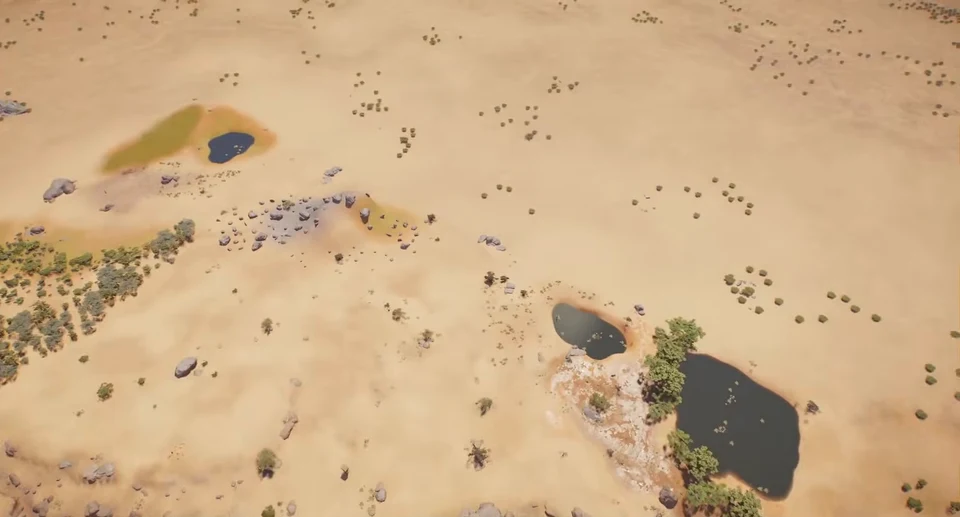
Paint the area with the Ecosystem Brush and give it the terrain and nature on its panel; each line turns teal when there is enough. Wetland, Swamp and Watering Hole need a water area. Savannah, Shrubland and Sandy Plain only allow a little water, so keep them away from ponds.
| Ecosystem | Terrain | Nature, and how much | Roles to flourish (Tanzania animals) |
|---|---|---|---|
| Grassland | Grass and Scrub Grass | Bushes: 125 or more; Trees: 75 to 400 | Grazers (Black Wildebeest, Blue Wildebeest, Common Hippopotamus, Common Ostrich, Nyala, Plains Zebra, Springbok or Thomson's Gazelle) and Soil Rooters (Aardvark or Common Warthog) |
| Savannah | Grass, Scrub Grass and Detritus | Pyrophyte Plants: 175 or more; Tree Litter: 125 or more; Termite Mounds: 5 or more; Acacia Trees: 35 or more | Scavengers (Nile Monitor, Secretarybird, Spotted Hyena or White-Backed Vulture), Low Browsers (Black Rhinoceros, Cape Buffalo or Sable Antelope) and Terrestrial Seed Dispersers (African Savannah Elephant, Black Rhinoceros, Black Wildebeest, Blue Wildebeest, Cape Buffalo, Common Ostrich, Gemsbok, Masai Giraffe, Nyala, Plains Zebra, Reticulated Giraffe, Sable Antelope or Springbok) |
| Dense Forest | Grass, Soil and Detritus | Tree Litter: 125 or more; Medium Rocky Cover: 30 or more; Spreading Crown Trees: 300 or more; Dense Crown Trees: 170 or more | High Browsers (African Savannah Elephant, Masai Giraffe or Reticulated Giraffe) and Terrestrial Seed Dispersers (African Savannah Elephant, Black Rhinoceros, Black Wildebeest, Blue Wildebeest, Cape Buffalo, Common Ostrich, Gemsbok, Masai Giraffe, Nyala, Plains Zebra, Reticulated Giraffe, Sable Antelope or Springbok) |
| Wetland | Grass, Wild Grass, Wetland Sediment and Waterlogged, plus a water area | Semi-Aquatic Plants: 325 or more | Wetland Engineers (Common Hippopotamus) and Underwater Grazers (Blunthead Cichlid) |
| Swamp | Grass, Soil, Wetland Sediment and Waterlogged, plus a water area | Freshwater Bed Plants: 175 or more; Semi-Aquatic Plants: 450 or more; Bushes: 100 or more; Semi-Aquatic Trees: 20 or more | Aerial Seed Dispersers (Greater Flamingo), Wetland Engineers (Common Hippopotamus) and Underwater Grazers (Blunthead Cichlid) |
| Watering Hole | Grass and Wetland Sediment, plus a water area | None | Wetland Engineers (Common Hippopotamus) |
| Shrubland | Scrub Grass, Soil and Detritus | Small Rocky Cover: 100 or more; Flowers: 250 or more; Bushes: 700 or more; Trees: 20 to 250 | Low Browsers (Black Rhinoceros, Cape Buffalo or Sable Antelope), Soil Rooters (Aardvark or Common Warthog) and Terrestrial Foragers (Aardvark or African Savannah Elephant) |
| Rocky Hills | Grass, Soil and Rock, plus ground above 15 m | Medium Rocky Cover: 50 or more; Large Rocky Cover: 60 or more | Grazers (Black Wildebeest, Blue Wildebeest, Common Hippopotamus, Common Ostrich, Nyala, Plains Zebra, Springbok or Thomson's Gazelle) and Low Browsers (Black Rhinoceros, Cape Buffalo or Sable Antelope) |
| Sandy Plain | Soil and Sand | Small Rocky Cover: 80 or more; Medium Rocky Cover: 40 or more; Bushes: 150 to 400 | Scavengers (Nile Monitor, Secretarybird, Spotted Hyena or White-Backed Vulture), Low Browsers (Black Rhinoceros, Cape Buffalo or Sable Antelope) and Terrestrial Foragers (Aardvark or African Savannah Elephant) |
The Riverine Ecosystem from the Great Rift Valley is not on Tanzania's brush. Watch the tree limits in the Grassland and Shrubland and the bush limit in the Sandy Plain. Going over the top number fails the line. Our Planet Zoo 2 reserve tracker keeps the role ticks for every reserve, and Planet Zoo 2 Ecosystem Roles lists who fills each role across the game.
Career mode: Tanzania Reserve Bronze, Silver and Gold
- Bronze: Establish 5 Ecosystems and release a Black Rhinoceros and African Leopard, then photograph both from the research vehicle. The leopard is the hard part: it needs the Flourishing Dense Forest and Wetland from the order above.
- Silver: Release and photograph a Cape Buffalo, Lion and African Savannah Elephant, and reach a Biodiversity Rating of 3.0 stars.
- Gold: Release the African Tigerfish and Blunthead Cichlid, finish 15 release groups, release and photograph a White-Backed Vulture and Secretarybird, have 9 Established Ecosystems (every one Tanzania has) and reach 5.0 stars.
Biodiversity rises with Established and Flourishing Ecosystems, the number of species released and a research network, and falls with pollution and invasive plants. How the Biodiversity Rating is scored has the steps. For the two fish, build the Swamp first: it is the only Ecosystem their panels ask for.
Release groups for Tanzania
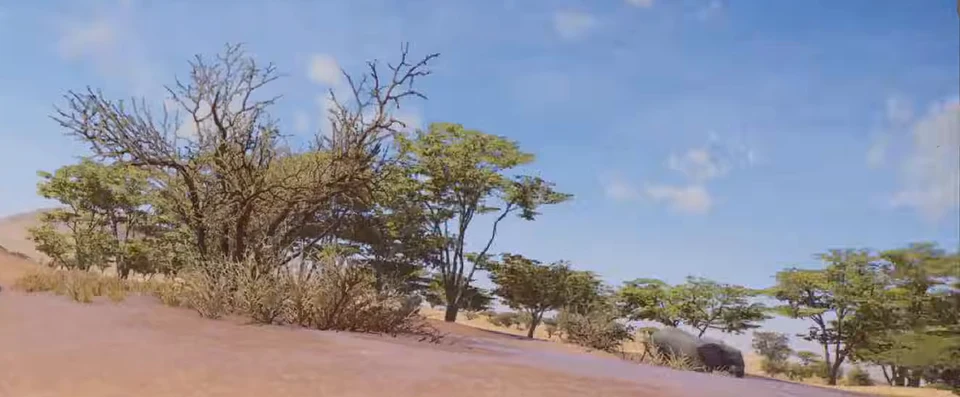
Each species has its own group types (a mixed herd, a male bachelor herd and so on); the Planet Zoo 2 release groups finder lists them for all 28. For the reserve itself, see the Planet Zoo 2 Wildlife Reserves guide, and compare the smaller Planet Zoo 2 Sweden Reserve.
Planet Zoo 2 Tanzania Reserve questions
What animals can you release in the Tanzania Reserve in Planet Zoo 2?
28: 20 mammals, five birds (Common Ostrich, Greater Flamingo, Secretarybird, Shoebill and White-Backed Vulture), the Nile Monitor and two fish (African Tigerfish and Blunthead Cichlid). The Common Ostrich and Thomson's Gazelle go to Tanzania and nowhere else; the other 26 can also go to the Great Rift Valley.
What Ecosystems are in the Tanzania Reserve?
Nine: Grassland, Savannah, Dense Forest, Wetland, Swamp, Watering Hole, Shrubland, Rocky Hills and Sandy Plain. There is no Riverine, so a release panel line that says "or Riverine" has to be met with the other Ecosystem it names.
Why can’t I release the African leopard in Tanzania?
Its panel asks for "Either Wetland or Riverine" and "Flourishing Dense Forest", plus Medium Prey already in the reserve. In Tanzania that means a Wetland, because there is no Riverine. The Dense Forest only flourishes once a High Browser (African Savannah Elephant, Masai Giraffe or Reticulated Giraffe) and a Terrestrial Seed Disperser are out. So release a giraffe first.
Which animals should I release first in the Tanzania Reserve?
21 animals only need their Ecosystems Established, so they can go first, in any order. Start with the ones that make Ecosystems flourish for the other seven: a giraffe for the Dense Forest, the Common Hippopotamus and Blunthead Cichlid for the Wetland, and a Scavenger such as the Secretarybird or Spotted Hyena for the Savannah.
How do I release the elephant in the Tanzania Reserve?
The African savannah elephant needs a Flourishing Savannah and a Flourishing Wetland. The Wetland flourishes when the Common Hippopotamus and Blunthead Cichlid are released; the Savannah needs Scavengers, Low Browsers and Terrestrial Seed Dispersers.
How do I make ecosystems flourish in the Tanzania Reserve?
First get the Ecosystem Established with its terrain and nature, then release animals that fill every role it lists. The Dense Forest needs High Browsers and Terrestrial Seed Dispersers; the Wetland needs the Common Hippopotamus and Blunthead Cichlid; the Watering Hole flourishes with the hippo alone. The table of the nine Ecosystems lists the Tanzania animals for each role.
Why can’t I release my animals into the Tanzania Reserve?
The release panel lists what is missing. Most often it is an Ecosystem still short of its terrain or plants, an Ecosystem that has to be Flourishing, a nest or burrow, or Medium Prey and Predators already in the reserve. A panel that offers Riverine needs the other Ecosystem, because Tanzania has no Riverine.
How do I get all 9 Ecosystems established in the Tanzania Reserve?
Paint each one with the Ecosystem Brush and give it the terrain and nature on its panel. Wetland, Swamp and Watering Hole need a water area, Savannah, Shrubland and Sandy Plain only allow a little water, and Rocky Hills need ground raised above 15 m. Gold asks for all 9.
How do I get a 5 star Biodiversity Rating in the Tanzania Reserve?
Establish and flourish as many Ecosystems as you can, release many different species, build a research network of Observation Platforms, Acoustic Monitors and Camera Traps, and clear pollution and invasive plants. Gold needs 5.0 stars.
What are the Gold objectives in the Tanzania Reserve?
Release the African Tigerfish and Blunthead Cichlid, finish 15 release groups, release and photograph a White-Backed Vulture and Secretarybird, have 9 Established Ecosystems and reach a Biodiversity Rating of 5.0 stars.
Sources
- Planet Zoo 2 Zoopedia: the Conservation section and Ecosystem Roles of each animal page (official)
- Planet Zoo 2 player guide: Wildlife Reserves, on Established and Flourishing Ecosystems (official)
Checked against the official pages on November 21, 2026.
Continue reading
 Next stepKnow what Tanzania needs? Build each release group the right way.Planet Zoo 2 Release Groups by AnimalWhich Wildlife Reserves each animal can go to and the release group types it lists, with a finder by reserve, group type and name.Go there
Related pages
 Ecosystem RolesPlanet Zoo 2 Ecosystem Roles by AnimalWhich animals fill each Ecosystem Role, from Low Browsers to Seed Dispersers, with a finder by role and reserve for Flourishing Ecosystems.
 Wildlife ReservesPlanet Zoo 2 Sweden Reserve: All 12 AnimalsThe 12 animals Sweden takes, the four that make all six of its Ecosystems flourish, the terrain and plants each Ecosystem needs, and the Career objectives in order.
